Manilovka
Dead SoulsManilovka, the country estate of Manilov, is introduced through a journey that turns a supposedly short visit into an extended search, then through a landscape whose polished, English-style garden cannot conceal the poverty and neglect around it. The estate becomes the setting for Paul Ivanovitch Chichikov’s first dead-soul transaction, revealing how a rural property, its registered serfs, and the tax system can be converted into instruments of speculation.
Approach and Setting
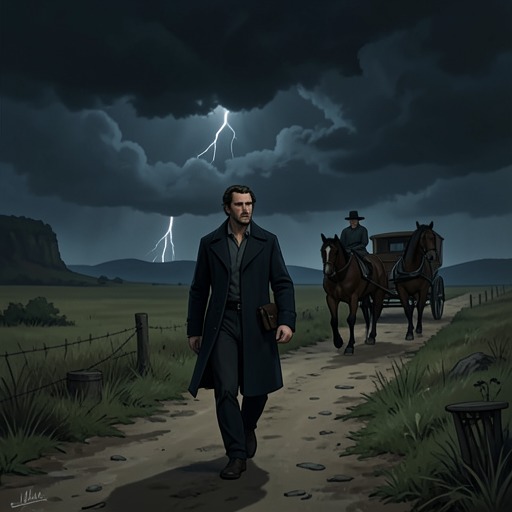
Manilov tells Chichikov that his house lies fifteen versts from town, but the road carries the travelers past the fifteenth milestone and then the sixteenth without bringing the estate into view. A peasant corrects Chichikov’s mistaken name for the place, explaining that it is Manilovka, not the nonexistent Zamanilovka, and directs the britchka onward. Even after the travelers reach the indicated road, they cover another two, three, or four versts before seeing the two-storied stone mansion. The narrator turns the discrepancy into a joke about invitations: a country house said to be fifteen versts away may prove to be at least thirty.
The distance is more than a navigational inconvenience. Chichikov’s route passes a familiar, unremarkable countryside, and the approach delays the promised encounter with the estate itself. The country appears not as an idealized retreat but as a broad, ordinary landscape in which directions and assurances prove unreliable. Manilovka’s name is a point of local correction, while its location seems to recede as the visitors pursue it.
The Estate Landscape
The house stands on an isolated rise, open to every wind. Its slope has closely mown turf and flower-beds arranged in the English fashion, with lilacs and yellow acacias; a few slender birches stand beside an arbor whose shabby green cupola and blue-painted supports carry the inscription “This is the Temple of Solitary Thought.” Below lies a green-coated pond, a common feature of Russian landowners’ gardens. The composition gestures toward cultivated taste, but its details are slight and worn: the arbor is shabby, the trees are few, and the house occupies an exposed, lonely position.
The view below the slope sharply qualifies the garden’s decorative order. A line of mouldy log huts stretches from the foot of the rise, and Chichikov counts more than two hundred without seeing a leaf of vegetation or a stick of timber beyond the logs themselves. Two women wade knee-deep in the pond, dragging a ragged fishing-net with wooden handles; it contains two crawfish and a roach, and the women appear to be quarrelling. A pinewood makes only a faint, dusky blur in the background. The sky is neither clear nor fully overcast, but a dull grey compared to a long-worn soldier’s uniform. Even the cock, with its head pecked bare by other cocks, flaps its stripped-looking wings and crows. The scene’s nominally landscaped estate is surrounded by signs of material thinness and wear.
The Dead-Soul Transaction
At Manilovka, Chichikov asks when Manilov last made a census return and whether many serfs have died since it was taken. The question connects the private property to the revision-list system: owners remain liable for tax on people still recorded as living even when they have died, while those recorded names can also carry financial value. Chichikov’s scheme is to acquire dead serfs at reduced rates, obtain a fictitious list, and use it as the basis for borrowing money to buy an estate and living serfs.
When Chichikov proposes the arrangement, he insists that it is above-board. Manilov is reassured, and the discussion turns to price. Yet Manilov refuses to charge anything for the dead souls, offering them unconditionally and volunteering to bear the sale expenses. Chichikov is visibly delighted: his convulsive movement tears the chair’s cushion covering, while the extravagant thanks he pours out leaves Manilov confused and blushing. This first transaction therefore depends not on a hard bargain but on the seller’s credulous generosity. The formal language of sale and transfer gives a legal shape to a deal whose objects are people no longer alive and whose value comes from their continued appearance on official rolls.
The Estate in the Wider Novel
Manilovka’s transaction makes concrete the economic mechanism behind Chichikov’s journey across Russia. Under the periodic census system, the owner continues paying tax for serfs who have died since the last revision; at the same time, the recorded population can serve as collateral for borrowing. Chichikov exploits the interval between census returns, proposing to purchase names that still count administratively and use them to establish a fictitious estate. The apparently small exchange at Manilovka is thus the opening move in a scheme that treats registration itself as a source of wealth.
The novel repeatedly places estate economies beside the consequences of the same population-and-property system. At the office, Sobakevitch’s list records each serf’s trade, age, and pedigree, along with marginal notes on conduct and sobriety, showing how individual lives are rendered legible as entries in a transaction. Much later, Khlobuev explains that of the hundred souls registered at his last revision only fifty survive after cholera, and that some of the survivors have absconded; the weakened estate is offered for thirty-five thousand roubles. Against these harsher instances, Manilov’s free transfer does not make the system benign. It reveals a different route through it: Chichikov’s profit depends on the administrative afterlife of the dead, while landlords bear the tax attached to names that outlast their owners.
Narrative Significance
The estate’s outward signs of refinement and its surrounding deprivation place appearance and material conditions in uneasy proximity. The English-style beds, the ornamental arbor, and its lofty inscription offer a cultivated surface; the exposed hill, mouldy huts, bare lack of vegetation, meager catch, and ragged net make that surface look insubstantial. Manilovka is not simply a picturesque backdrop for a negotiation. Its landscape gives the transaction a setting in which property is carefully named and ornamented even as the rural life below it appears neglected.
The delayed arrival also establishes the novel’s wider movement through roads, estates, and landowners. Chichikov’s scheme supplies the pretext for his travels, while each visit opens a different view of the society that makes his fraud conceivable. At Manilovka the governing contradiction is already clear: the dead serfs have vanished as people, yet remain present as taxable, transferable, and potentially mortgageable names. The estate is where that contradiction first becomes an exchange.